
 Keep your home running smoothly year-round. Central heating checklists and boiler safety to plumbing fixes and electrical tips, we provide the practical advice every homeowner needs to prevent costly repairs.
 Transform your living space with our expert guides on flooring, painting, and kitchen renovations. Learn how to clean delicate surfaces like marble or choose the right fixings for your next big indoor project.
 Enhance your curb appeal and enjoy your outdoor space. Discover the best lawnmowers for your garden, landscaping inspiration, and durable solutions for fencing, patios, and home exterior maintenance.

A canvas print usually looks easy to live with. It has no glass to polish and no heavy frame to fuss over. Still, the surface collects dust, the wooden stretcher reacts to damp air and strong daylight slowly changes colour. Most damage does not arrive as one dramatic accident. It builds through ordinary habits.Where the print is hung, how it is handled and understanding when to leave a mark alone are the main components of a safer practice.
Why Proper Care Is Essential for Long-Lasting Canvas Prints

Canvas prints sit in real rooms, not museum cases. A radiator warms one wall each winter. Over time, those small things matter.
Canvas and wooden stretcher bars respond to changes in moisture. Repeated swings between damp and dry conditions can leave the fabric slack, rippled or pulled at the corners. Dust creates another problem. On some acrylic surfaces, dirt settles into a soft paint film and becomes difficult to remove without changing the finish.
Prevention is less risky than cleaning. A print kept away from heat, moisture and busy walkways needs less attention later. In fact, by identifying and addressing loose corners, a bent frame or fresh spotting early on is easy.
How to Clean Your Canvas Print Without Damaging the Artwork
The top border is often dusty. Even though it’s tempting to use a moist towel, the printed surface is not a kitchen counter. Cloth fibres can catch on texture. Moisture may leave a tide mark and a stiff brush can scratch the surface.
Meanwhile, the conservation guidance also warns against feather dusters, household vacuums and compressed air on paintings.
In order for you to clean the frame and outside borders, just use a clean, dry cloth, being careful not to smear the image. While holding the print upright, gently scrape any dust off a hard, undamaged surface to remove it.
Quickly discontinue use if you see any lifting of color, sticky surface or powdery consistency.
Modifying the coating or making a light-catching patch is as easy as using a spray, baby wipes, alcohol or furniture polish. On the whole, if you rely on such factors, it won’t be an issue. However, we have a lot more to guide you forward.
The Best Ways to Display Canvas Prints to Preserve Their Quality
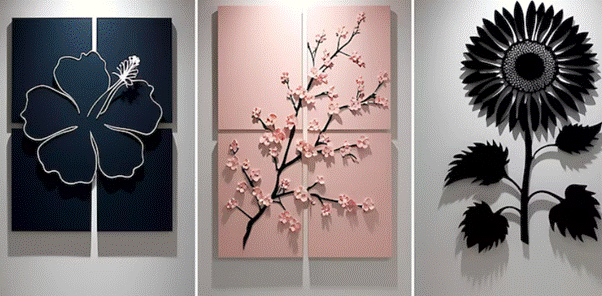
Placement should begin with the room rather than the empty wall. A canvas above a radiator may receive rising heat every day. One near a cooker picks up grease. Bathrooms and poorly ventilated rooms bring repeated moisture changes. A calmer living room or bedroom wall is generally easier on the fabric.
The fixing must suit the weight of the print. Wider pieces sit more steadily on two secure points and are less likely to twist. When the print is moved, it should be held by the frame or stretcher sides. Fingers pressed into the centre can leave a dent that remains visible in angled light.
Bold pieces such as African Canvas Wall Art often rely on deep colour and clear contrast. Those details show uneven fading quickly, so a wall beyond direct sun is a better choice than a bright spot opposite a window. Clean hands also matter because oils can leave marks along painted edges.
How to Protect Canvas Prints from Sunlight, Humidity and Dust
Sun damage occurs so gradually you don’t even realize. One side of a print may fade and the remainder still seem normal. Yet, there’s the case as to how blinds can be beneficial and give perks. For you see, nnot just blinds but there are curtains or UV-filtering window film,, which can limit exposure, however no filter blocks all hazardous wavelengths. It is still easier to move a print-out away from direct light for protection.
Also, humidity requires calm attention. Conservation guideline suggests that a constant relative humidity between 40 and 60 percent is in the safer range for canvas paintings. A house does not need museum equipment, but moisture, a musty smell or a canvas that frequently sags all hint to a bad site.
Dust control starts with the room. Regular floor cleaning and a sensible distance from open windows reduce what lands on the print. A backing board can also limit dust reaching the rear and provide some protection from short environmental changes. It should be fitted without pressing against the canvas.
How to Store Canvas Prints Safely When Not on Display

Storage isn’t simply removing a print off the wall and putting it up in a spare room. Garages, sheds, attics, these are the matters that could result in fast-changing temperature. In fact, such areas are also more likely to suffer from humidity, insects and unintentional knocks.Furthermore, as you focus on the inside cupboard with steady conditions is usually the better option.
A stretched print should be stored upright on a clean raised surface. It needs support so it cannot slide or bow. Several works should not be stacked flat because the lower frames carry the weight. Nothing should lean into the front or back of the canvas.
A clean protective cover keeps off dust, but the covering should not stick to the image. Archival tissue or acid-free board can separate framed pieces. Bubble wrap is useful during a move, though tightly sealed plastic is a poor long-term choice where moisture might become trapped. Wrapping can offer useful short-term physical protection during transport.
The print should be checked before it goes into storage and again before rehanging. A quick photograph provides a record of its condition. Labels belong on the outer wrapping, not on the artwork or stretcher.
Signs Your Canvas Print Needs Professional Restoration

A small dent may settle once pressure is removed, but cracks, tears and lifting colour need more caution. Home repairs often create a second problem. Tape stains the fabric. Glue spreads beyond the tear. Touch-up paint changes colour differently as it dries.
Professional advice is sensible when there is:
- Flaking or powdery colour
- A tear, puncture or deep dent
- Rippling that does not settle
- Water staining or dark spotting
- A musty smell
- A twisted frame or loose stretcher
- Damage after a fall
Mould should not be brushed indoors because spores can spread through the room. A damaged area should not be pressed flat from behind either. Canvas conservators are trained to assess the surface, support and frame together, then decide whether cleaning, stabilisation or repair is appropriate.
Conclusion
Good canvas care is rarely complicated. A steady room, indirect light and gentle handling prevent more damage than frequent cleaning. When a print starts to sag, crack, stain or flake, an early professional opinion is safer than a home repair. Small habits keep the colour, surface and frame in better shape for the years ahead.